
The Incredible Journey of a Female Hummingbird Raising Her Chicks
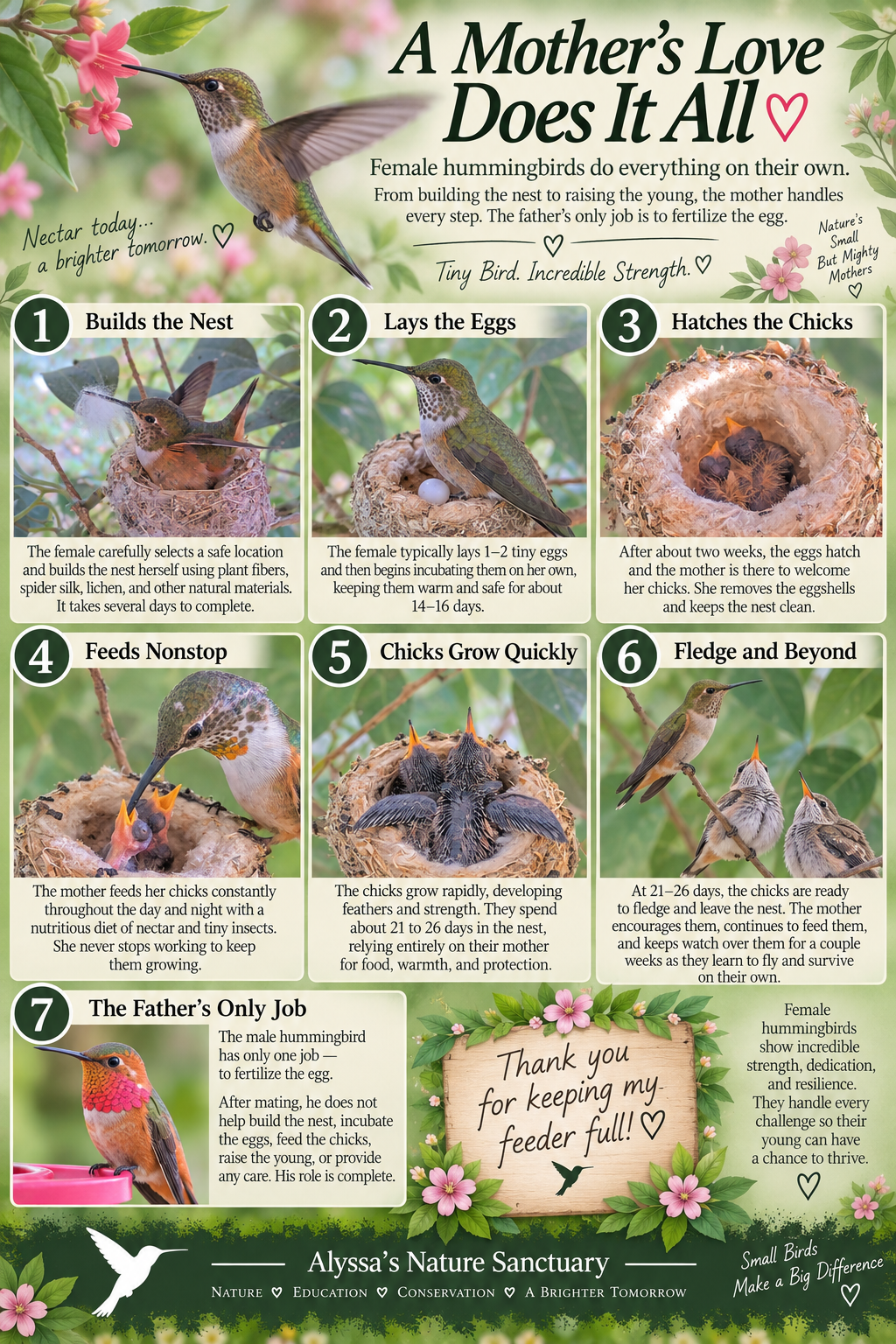
Thank you for Keeping my Feeder Full
The Remarkable Job of a Mother Hummingbird
When it comes to raising a family, a female hummingbird does it all on her own. From the moment she selects a nesting location until her young are capable of surviving independently, virtually every responsibility belongs to Mom.
She chooses the nest site, gathers the materials, builds the nest, lays the eggs, incubates them, protects them, keeps the newly hatched chicks warm, finds food, feeds them throughout the day, and prepares them for life outside the nest. Even after the young hummingbirds take their first flights, her work continues as she feeds and cares for them while they learn how to survive on their own.
The male hummingbird does not help build the nest, incubate the eggs, feed the chicks, protect the nest, or raise the fledglings. His reproductive role is essentially complete after mating and fertilization.
For such a tiny bird, the amount of work performed by one mother is extraordinary.
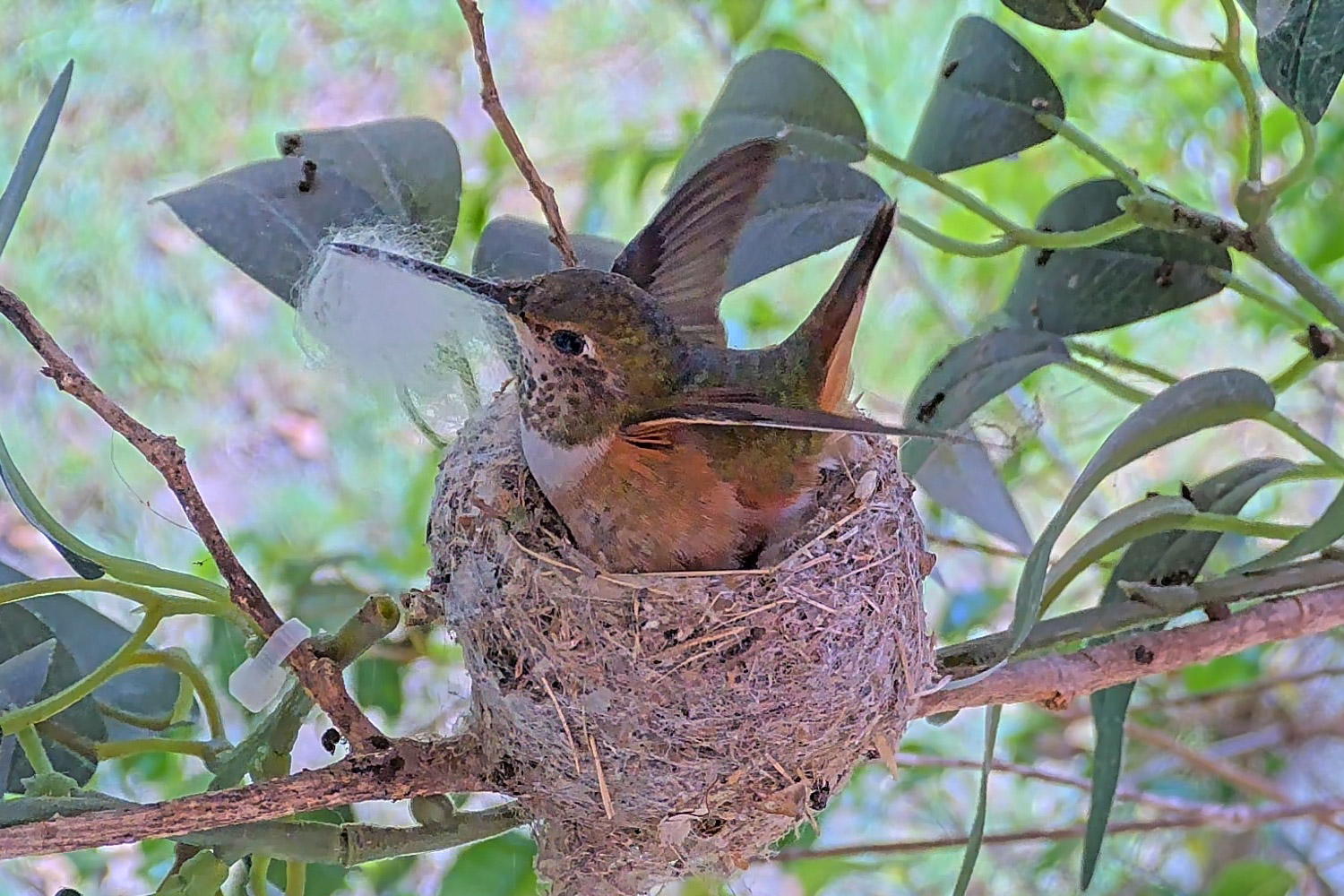
Nesterations
Building the Nest
The nesting process begins when the female searches for a safe, sheltered location where she can build her tiny nursery. Depending on the surroundings, she may choose a protected branch surrounded by foliage that provides both support and camouflage.
Once she finds the right location, construction begins—and she does all of it herself.
Hummingbird nests may appear delicate, but they are remarkable little structures. Mom gathers tiny pieces of plant material, fine grasses, bark fibers, bits of leaves, lichen, plant down, and other lightweight natural materials.
The interior is lined with especially soft material, creating a warm, insulated cradle for the eggs and eventually the chicks.
One of her most important construction materials is spider silk.
She uses spider silk to bind the nesting materials together and help attach the nest securely to its supporting branch. Spider silk is particularly well suited for the job because it is both strong and flexible.
That flexibility becomes extremely important later.
The nest that initially needs to accommodate only two tiny eggs will eventually need to hold two rapidly growing hummingbird chicks. Because spider silk can stretch, the nest is able to expand as the babies grow.
Even after the basic nest is completed, Mom may continue working on it. She can add material, reinforce areas, reshape portions of the nest, and attach small pieces of lichen and other natural materials to the exterior.
These finishing touches do more than make the nest stronger. They also help camouflage it by allowing the tiny structure to blend into the surrounding branches and vegetation.
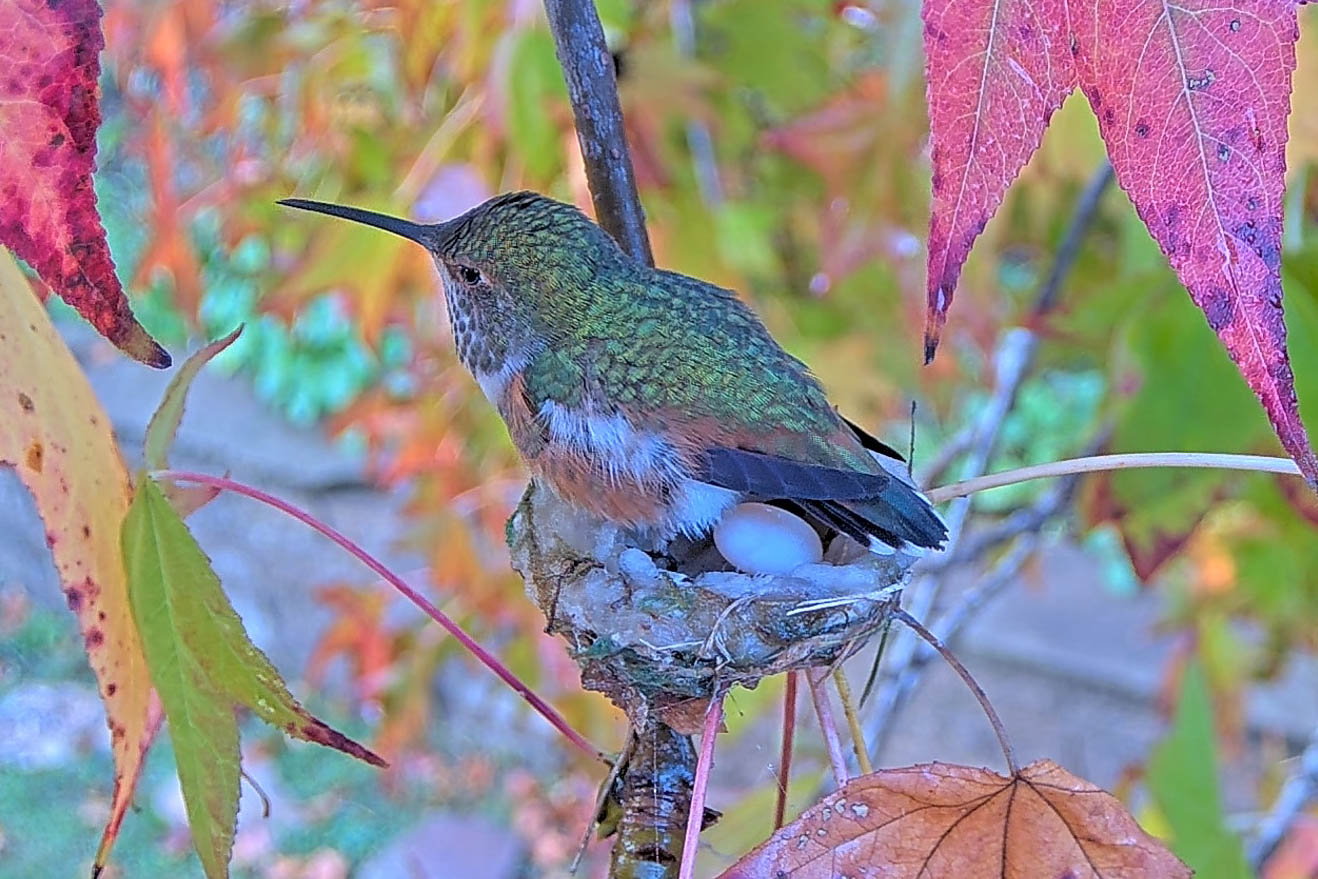
Egg Lay
Two Tiny Eggs
Once the nest is ready, the female typically lays two tiny white eggs, each approximately the size of a Tic Tac.
The eggs are not usually laid at the same time. Mom generally lays the first egg and then lays the second approximately 48 hours later.
Now another demanding stage begins:
Incubation.
For roughly two weeks, Mom is responsible for maintaining the conditions necessary for the embryos developing inside those tiny eggs.
There is no male hummingbird arriving to take the next shift.
Mom must balance two competing needs. She needs to spend enough time sitting on the eggs to keep them properly warmed, but she must also leave periodically to find enough food to sustain herself.
That means repeatedly leaving the nest, feeding, and returning to continue incubation.
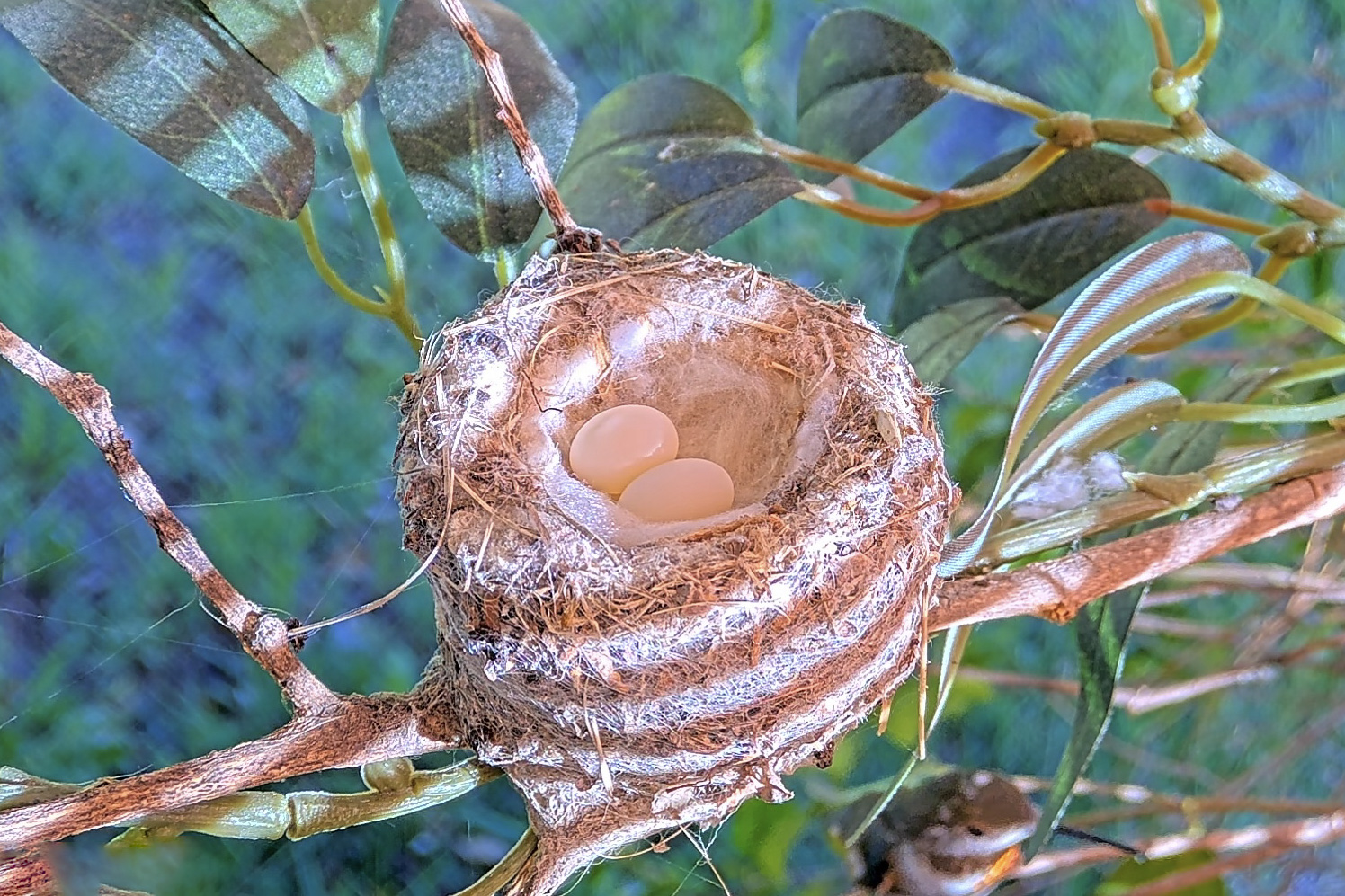
Two Eggs the Size of Tic Tac's
While incubating, she adjusts her position and periodically turns or rolls the eggs. This helps keep the developing embryos properly positioned and evenly warmed.
For days, this routine continues.
Sit.
Incubate.
Leave to eat.
Return to the nest.
And repeat.
And this is only the beginning.
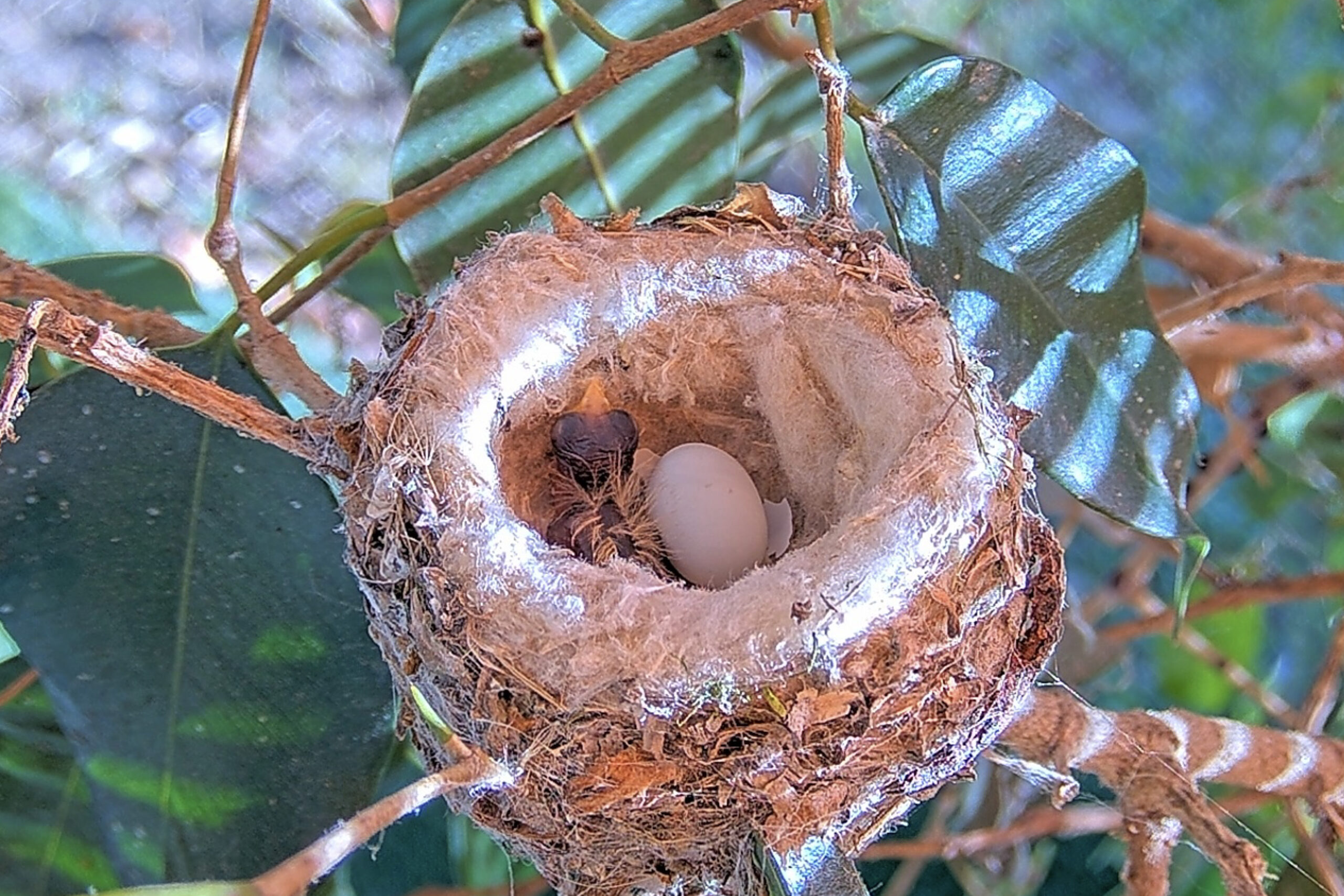
First Chick Hatches
The Chicks Hatch
After roughly two weeks of incubation, the tiny eggs begin to hatch.
For Mom, the incubation stage may be ending, but an even more demanding phase of motherhood is just beginning.
Newly hatched hummingbirds are incredibly tiny, fragile, and almost completely helpless. Their eyes are closed, their bodies are mostly bare, and they have only a small amount of sparse down.
At this age, they cannot adequately regulate their own body temperature. They depend on Mom for warmth as well as food and protection.
During these first days, she spends considerable time brooding her chicks, using her own body to keep them warm.
As the babies grow and develop feathers, their ability to maintain their body temperature gradually improves. Mom can then spend progressively more time away from the nest searching for the enormous amount of food required to support her growing family.
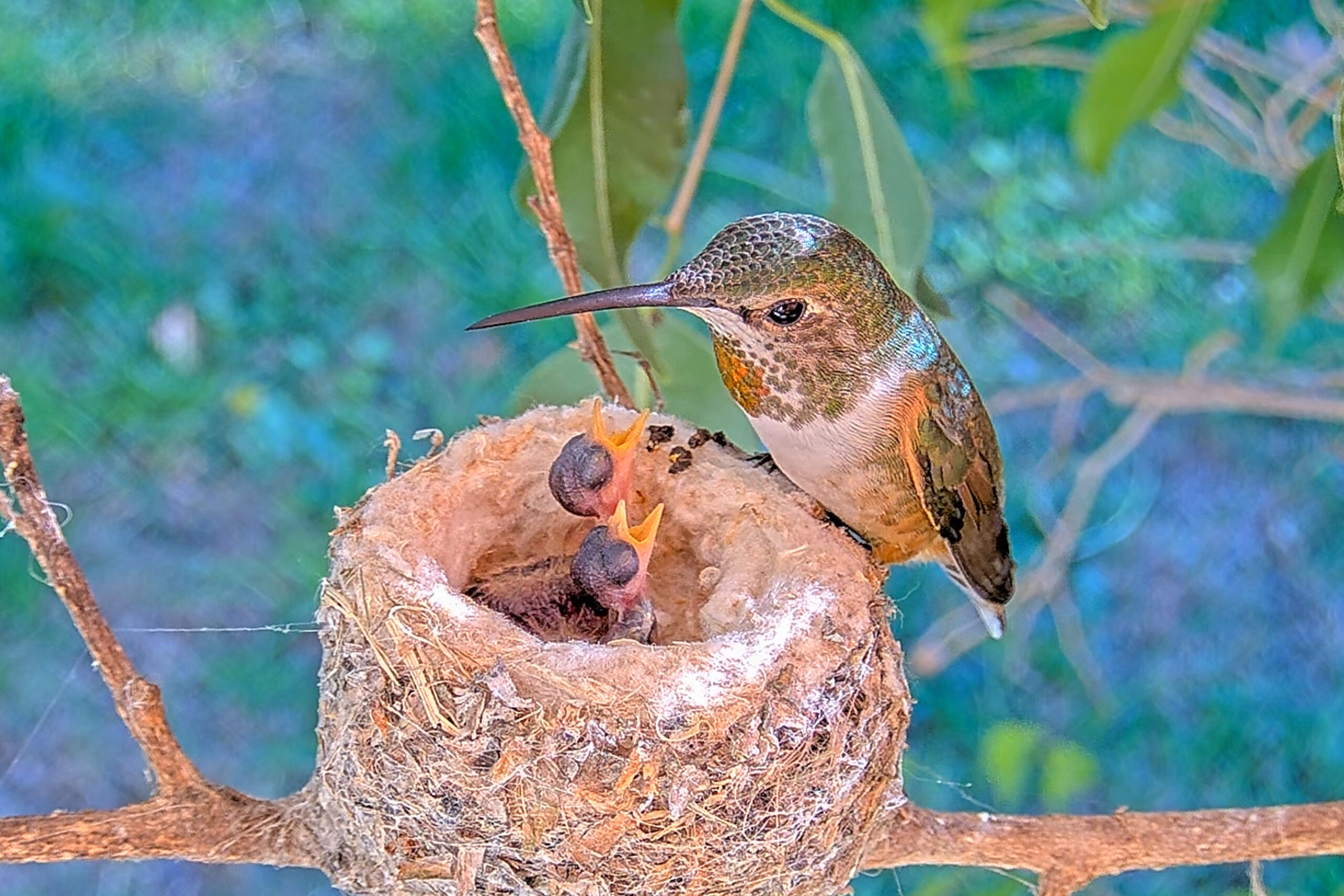
Mom and Chicks
An Amazing Transformation
Hummingbird chicks grow remarkably quickly.
Within only a few days, their appearance begins changing. Their developing feathers emerge as pinfeathers, which initially resemble tiny dark tubes or spikes.
Inside those protective sheaths are the feathers that will eventually open and cover their bodies.
Day by day, the transformation becomes more noticeable.
Their bodies become larger and stronger.
Their bills lengthen.
Their wings develop.
More feathers appear across their heads, backs, and bodies.
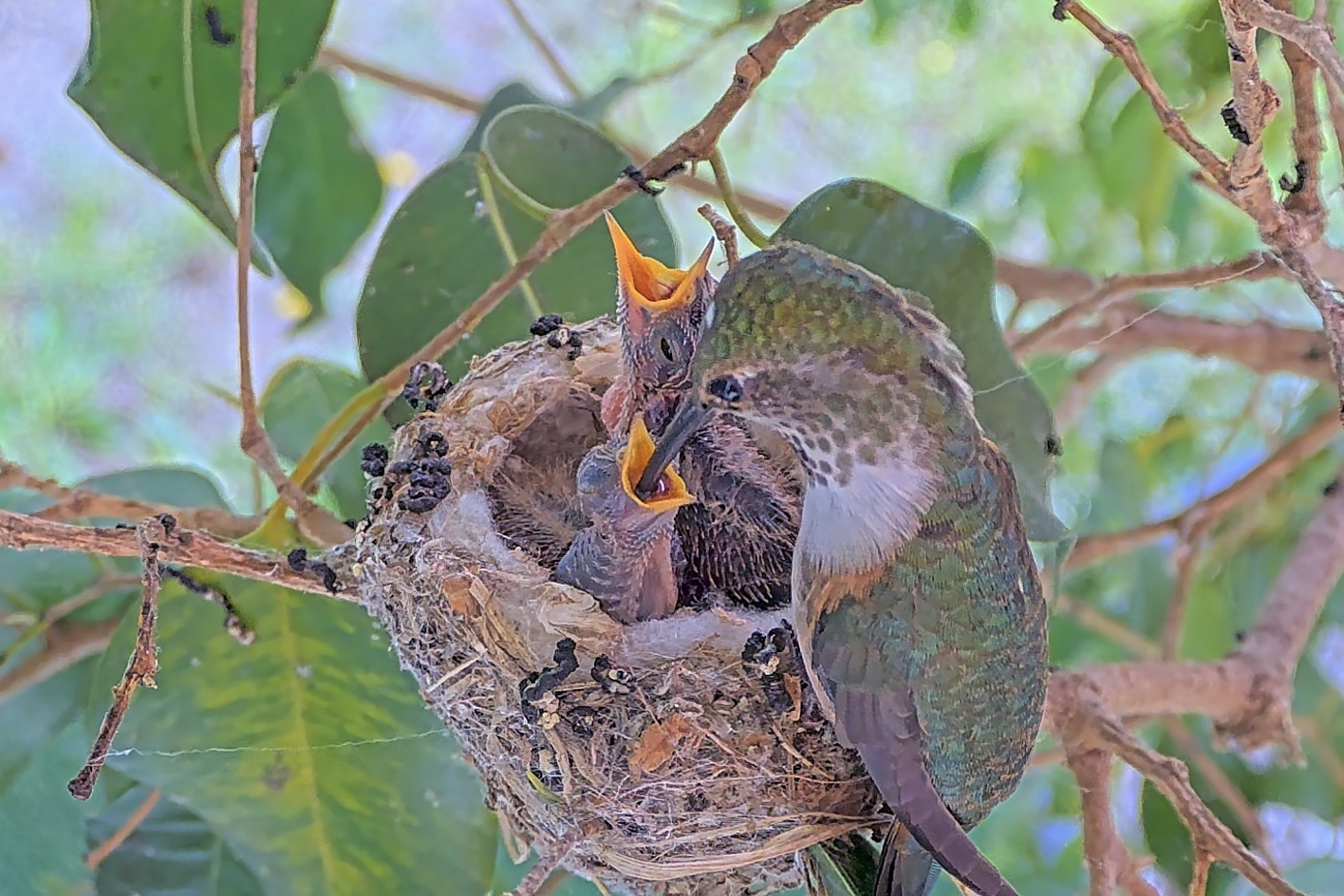
Nine Days Old Eyes Starting to Open
At approximately 7 to 9 days old, their eyes begin to open. For the first time, the chicks can really begin observing the world surrounding their tiny nest.
They become more alert and increasingly responsive to movement—especially when Mom arrives with food.
Soon they also begin exercising their developing bodies. They stretch, reposition themselves inside the nest, and begin making their first small attempts at flapping their wings.
Those early movements may not look very impressive, but they are the beginning of something extremely important.
They are preparing to fly.
Mom's Workload Becomes Enormous
As the chicks grow, so does their need for food.
Mom must now find enough nutrition not only to sustain herself but also to support two rapidly developing hummingbirds.
Throughout the day, she repeatedly leaves the nest in search of food and then returns to feed her babies.
Growing hummingbirds require tremendous amounts of energy and nutrients. Their diet includes nectar for energy along with tiny insects and spiders that provide important protein and other nutrients needed to develop muscles, bones, feathers, and the rest of their rapidly growing bodies.
When Mom returns, the chicks recognize her arrival and immediately respond.
Heads rise.
Mouths open.
And the begging begins.
Mom feeds each chick directly, inserting her long bill into the chick's mouth and regurgitating food from her crop.
Then she leaves to find more.
And comes back.
And leaves again.
From morning until evening, the cycle continues:
Find food. Return to the nest. Feed the chicks. Find more food.
As the chicks become larger, their nutritional requirements increase even further. Mom must keep up with two babies undergoing an extraordinary transformation from nearly naked hatchlings into fully feathered young hummingbirds in only a few weeks.
And throughout the entire process, she is still doing everything by herself.
There is no male bringing food to the nest.
There is no second parent taking over while she rests.
Mom alone is responsible for raising her young.
Growing Up Fast
For approximately 21 to 26 days after hatching, depending on the individual birds and environmental conditions, the chicks remain in the nest under their mother's care.
During those few short weeks, they undergo an incredible transformation.
The tiny nest that once comfortably held two Tic Tac-sized eggs soon becomes crowded with two rapidly growing hummingbirds.
In less than a month, the chicks must develop nearly everything they will need for life outside the nest: feathers, flight muscles, strength, coordination, balance, and the ability to fly.
Mom Begins Spending Less Time on the Nest
During the chicks' earliest days, Mom spends considerable time brooding them because they cannot adequately regulate their own body temperature.
As their feathers develop and provide better insulation, that begins to change.
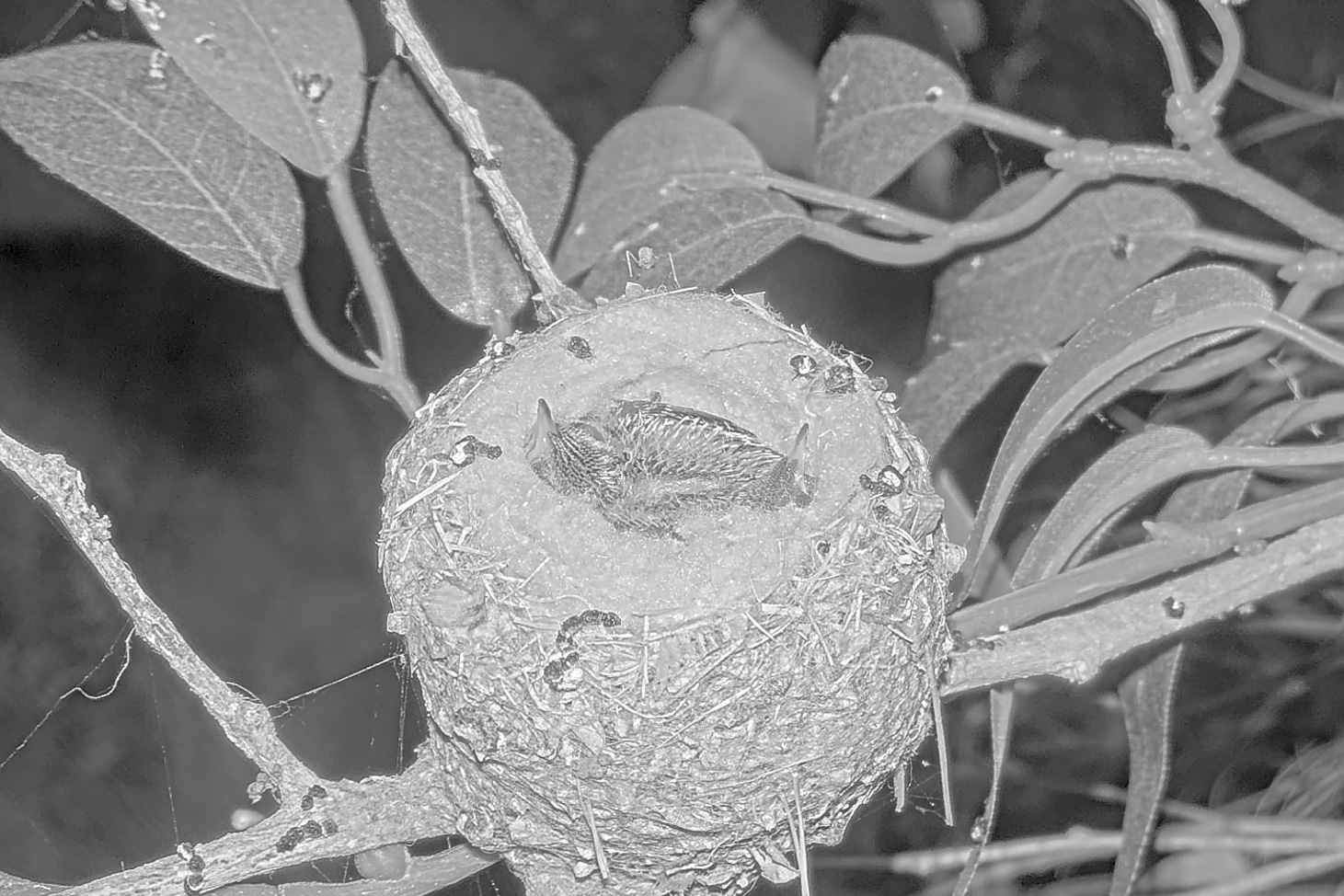
Chicks First Night Alone
At around 12 days old, Mom may stop sleeping on the nest at night. By this point, the chicks are becoming increasingly capable of maintaining their own body temperature.
There is also another very practical reason:
There simply isn't much room left!
The tiny nest that once contained two eggs is now packed with two growing hummingbirds.
The spider silk woven throughout the structure allows the nest to stretch and expand, but eventually even this amazingly flexible little home becomes crowded.
Mom continues returning throughout the day to feed and care for her babies, but the chicks themselves are beginning to change dramatically.
Time to Start Doing “Flappies”
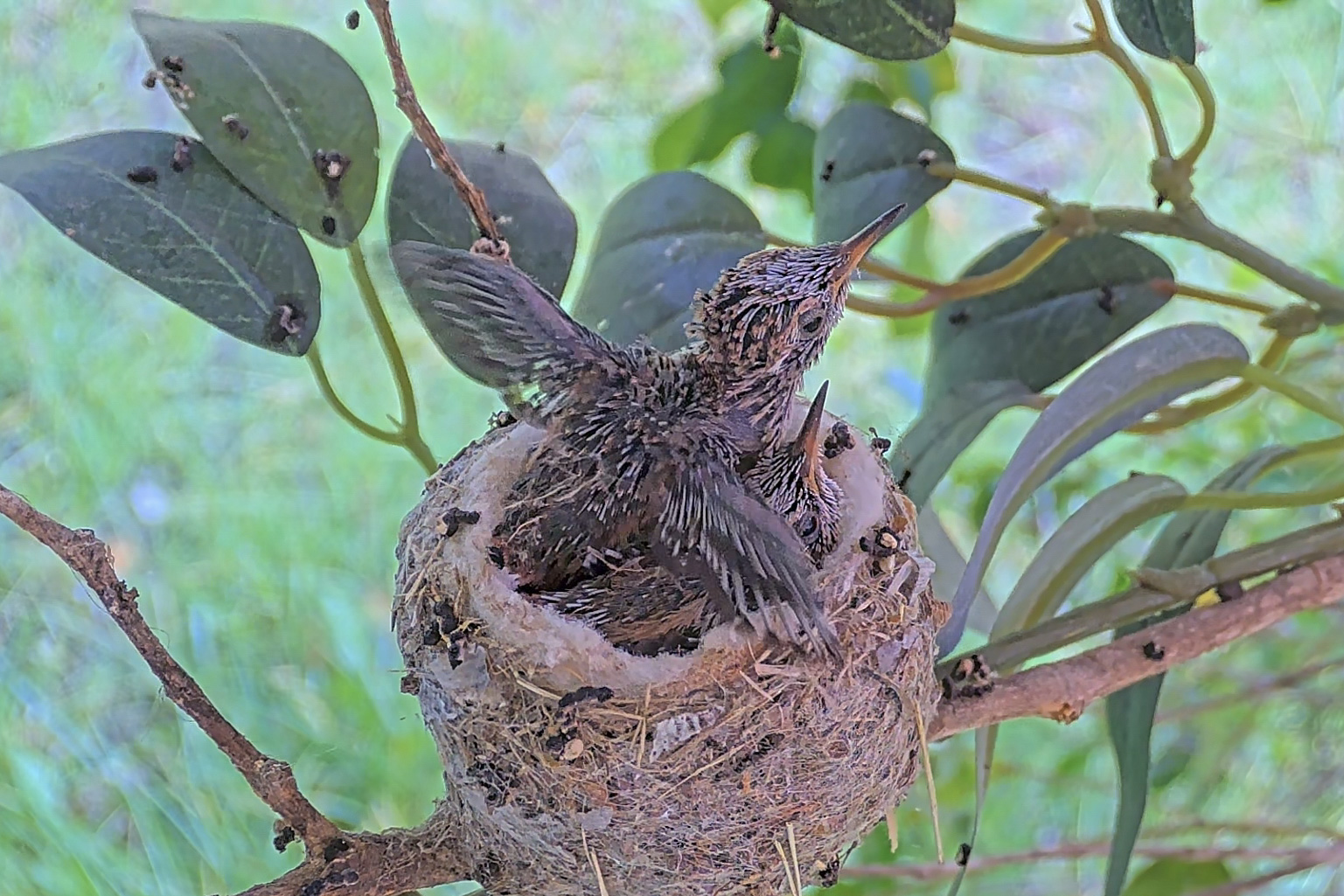
Chicks Doing Flappies
One of the most entertaining stages begins when the chicks start seriously exercising their wings—something we like to call “doing flappies.”
At first, their movements can be small and awkward. A chick may stretch its wings or give them a few uncertain flaps before settling back into the nest.
But there is a very important purpose behind all that activity.
Every flap helps strengthen the muscles needed for flight. The chicks are also developing coordination and learning how their wings interact with the air.
And they practice—a lot.
As the days pass, those wingbeats become faster, stronger, and more coordinated.
The chicks may brace their feet against the nest and flap vigorously. Eventually, they begin producing enough lift that their bodies can rise slightly above the nest while their tiny feet remain attached to the rim.
For a few moments, they are almost flying.
Then they settle back down.
And try again.
Every practice session brings them a little closer to their first real flight.
Their World Becomes Bigger
Their behavior changes in other ways as well.
As tiny hatchlings, their world consisted primarily of warmth, food, sleep, and Mom.
Now they are becoming curious.
They watch Mom arrive and leave.
They observe other hummingbirds flying past.
They respond to movement and sounds.
They watch leaves blowing in the wind, insects passing nearby, and activity in the surrounding trees.
The nest is no longer their entire world.
It is becoming their launching platform into a much larger one.
Learning to Perch
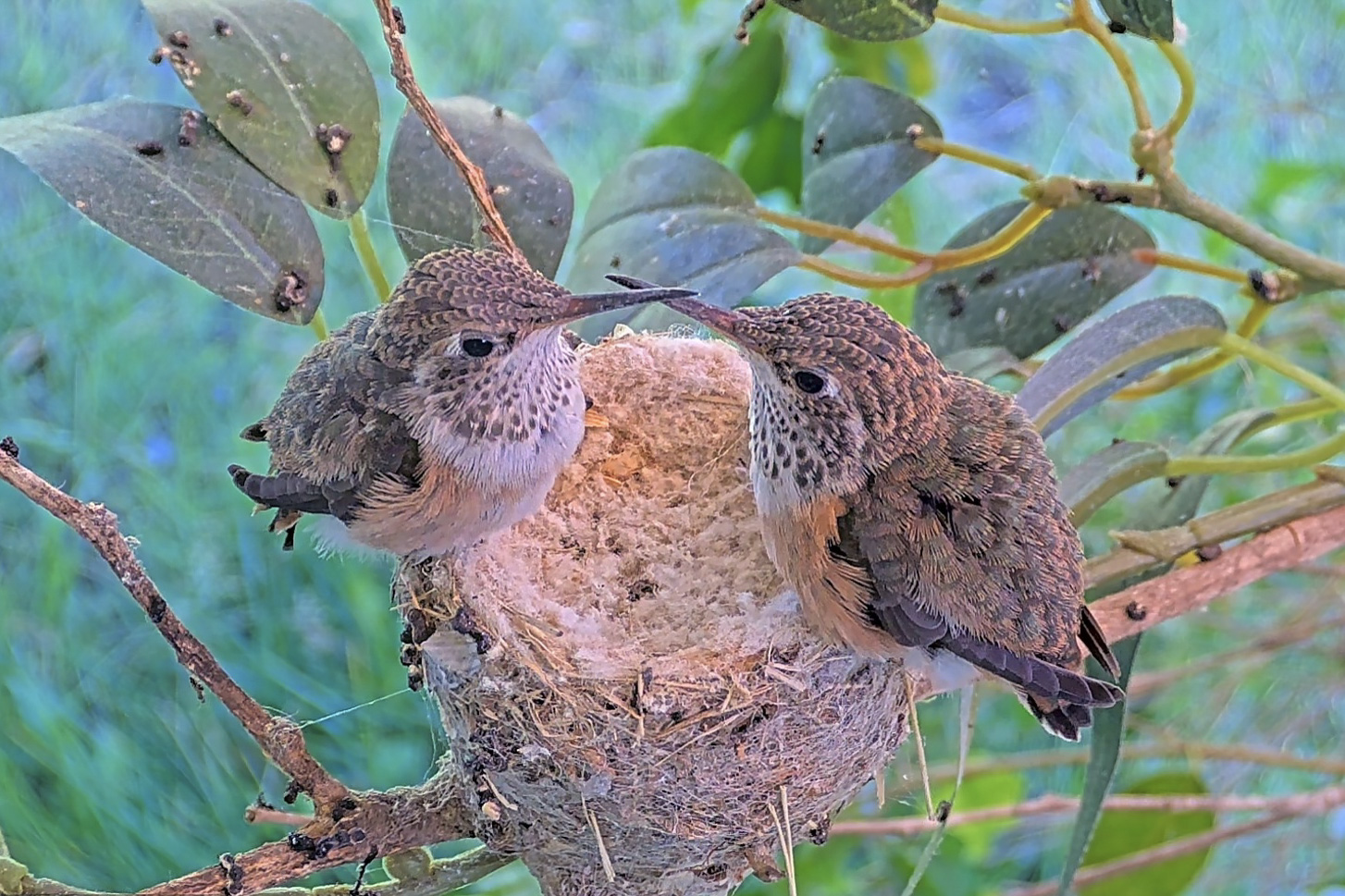
Chicks Perching
As their legs and feet become stronger, the chicks begin moving higher in the nest and eventually start perching on the rim.
This is another important step toward independence.
Balancing on the narrow edge helps develop the strength and coordination they will soon need to land and perch on branches.
At first, they may look a little uncertain.
That quickly changes.
Before long, the chicks confidently sit on the rim of the nest and observe everything around them.
They stretch.
They preen their new feathers.
They scratch.
They move around the nest.
They watch Mom come and go.
And, of course, they do more flappies.
Every day brings them closer to one of the most important moments of their lives.
Fledging Day — Their First Flight
Then comes one of the most remarkable moments of the entire nesting cycle:
Fledging day.
For roughly three weeks, the nest has been the center of the chicks' world. It is where they hatched as helpless babies, where Mom kept them warm, and where she returned countless times with food.
It is where their eyes opened.
It is where their feathers developed.
It is where their wings grew stronger.
And it is where they learned to balance, stretch, preen, observe, and practice flying.
Now, at approximately 21 to 26 days old, everything they have been practicing is about to be put to the test.
The Moment Finally Arrives
As fledging approaches, the chicks spend more time sitting on the rim of the nest.
Their wing exercises become increasingly vigorous. They may repeatedly lift their bodies above the nest while continuing to grip the edge with their feet.
Then, sometimes with very little warning, instinct takes over.
One chick releases its grip.
Its wings begin beating.
And suddenly...
It flies.
For the first time in its life, there is no nest underneath it.
The wings it has spent days strengthening are now supporting its entire body in the air.
Its first flight may be relatively short. The young hummingbird might fly to a nearby branch, shrub, or tree and sit quietly while it rests and takes in its completely new surroundings.
But that short flight represents an enormous achievement.
The tiny, nearly featherless hatchling from only a few weeks earlier has officially become a fledgling.
The Chicks Don't Always Leave Together
When a nest contains two chicks, they do not necessarily fledge at the same time.
Often, one chick leaves before the other.
The first may suddenly fly away while its sibling remains sitting in the nest.
The remaining chick might stay behind for several more hours—or sometimes longer—before deciding it is ready to make its own first flight.
For Mom, this creates another challenge.
She may now have two babies in two completely different places.
One chick may still be sitting in the nest waiting to be fed, while its sibling is perched somewhere in a nearby tree.
Mom continues caring for both.
She may return to feed the chick still in the nest and then fly away to locate and feed the fledgling that has already left.
Eventually, the second chick takes its first flight as well.
And for the first time since Mom laid her eggs, the nest is empty.
But Mom's job still isn't finished.
Life After the Nest
Leaving the nest is a major milestone, but fledging does not mean independence.
For the next several days to a couple of weeks, the young hummingbirds may continue depending on Mom while they develop the skills necessary to survive on their own.
They can fly, but they are still inexperienced youngsters.
Now they have to learn how to be hummingbirds.
Learning Life Outside the Nest
During their first days after fledging, the youngsters may remain relatively close to the nesting area.
Instead of having both babies conveniently located inside one tiny nest, Mom may now need to keep track of two mobile youngsters sitting on completely different branches or even in different trees.
The fledglings may perch quietly for long periods while waiting for her.
When Mom approaches, they may become excited, call, flutter their wings, and beg for food.
And Mom continues feeding them.
She gathers food, finds each youngster, feeds it, and then heads off again.
One fledgling may be high in a tree.
The other may be hidden in a shrub.
A little later, both may have moved.
Somehow, Mom keeps track of her family.
Learning to Find Food
Until now, the chicks haven't had to worry very much about where food comes from.
Mom brought it to them.
After fledging, that begins to change.
The youngsters start exploring their environment and investigating flowers, flowering plants, feeders, and places where tiny insects can be found.
They may observe Mom and other hummingbirds as they feed.
At first, the youngsters can appear uncertain.
They investigate.
They watch.
They experiment.
And gradually, they learn.
They become better at hovering in front of flowers, positioning themselves correctly to feed, maneuvering through foliage, and searching for the tiny insects that provide an important source of protein.
Mom continues supplementing their diet during this learning period, but gradually the balance changes.
Every day, the fledglings find a little more food for themselves.
And every day, they become a little less dependent on Mom.
Learning to Master Flight
A fledgling's first flight proves that it can fly.
It does not mean that it has mastered flying.
At first, young hummingbirds may appear cautious and inexperienced. Their landings aren't always perfect, and their movements may lack the incredible precision we associate with adult hummingbirds.
But that changes remarkably quickly.
Every flight is practice.
Every landing improves coordination.
Every trip through the branches strengthens muscles and sharpens reflexes.
Their hovering improves.
Their turns become sharper.
Their landings become more precise.
They begin flying farther from the nesting area and exploring more of their surroundings.
Watching this transformation is especially entertaining.
One day, they look like youngsters cautiously trying to figure out how to get from one branch to another.
Then it seems as though somebody flips a switch.
Before long, they're racing through the trees, darting around branches, diving, hovering, chasing one another, and maneuvering through the yard like tiny Top Gun fighter jets.
It is hard to believe these are the same little birds that only a few weeks earlier were helpless hatchlings unable to see or even keep themselves warm.
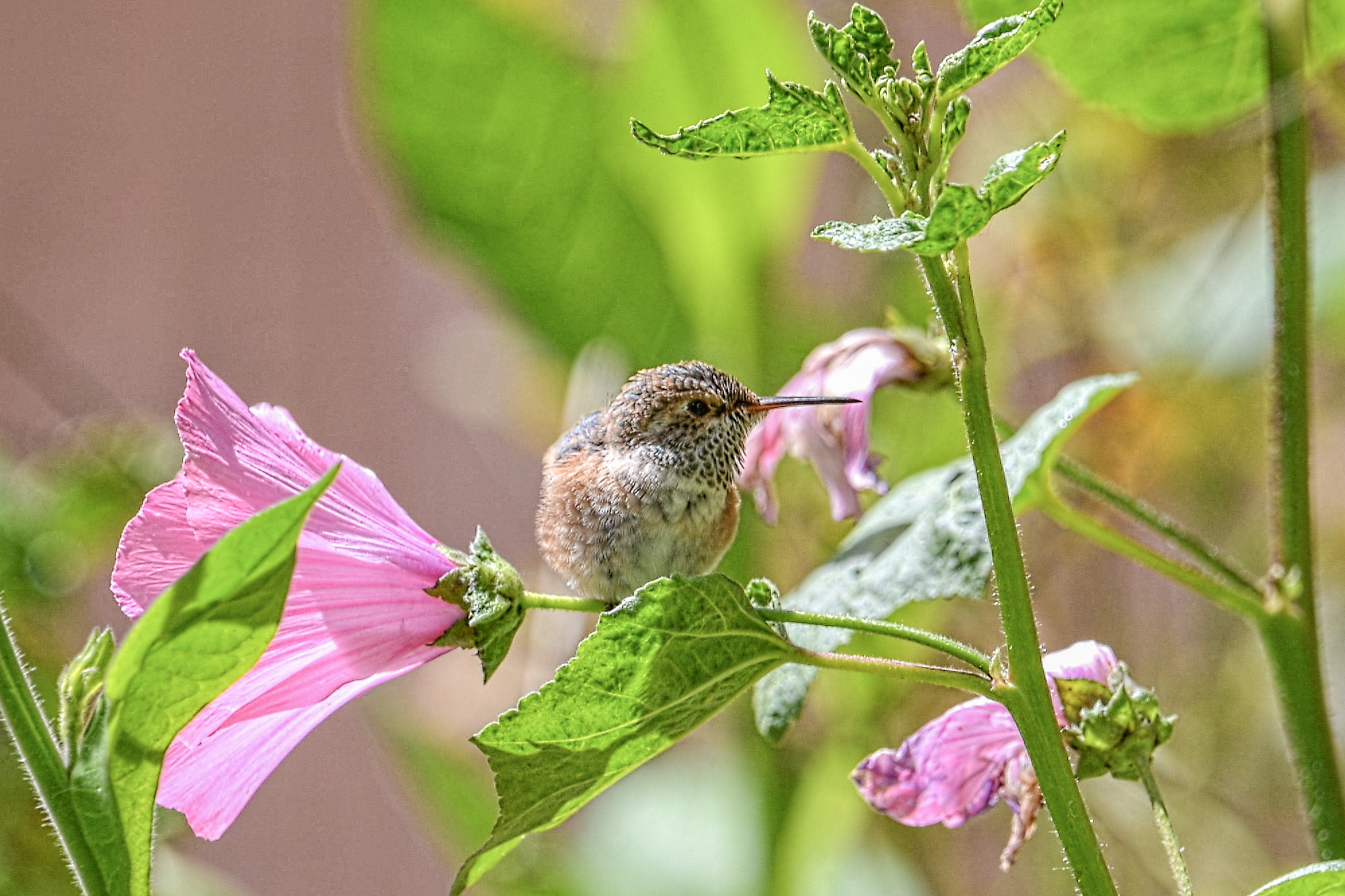
Butterfly Garden
Becoming Independent
Eventually, the youngsters become increasingly self-sufficient.
They learn where to find nectar and insects.
They learn where to perch.
They become accomplished fliers.
They learn how to navigate their environment and respond to the other hummingbirds around them.
And gradually, Mom's feedings become less necessary.
The young hummingbirds no longer need her to provide every meal.
They no longer need her to keep them warm.
They no longer need the protection of their nest.
Eventually, they are capable of surviving independently.
After weeks of extraordinary work, Mom has successfully raised her family.
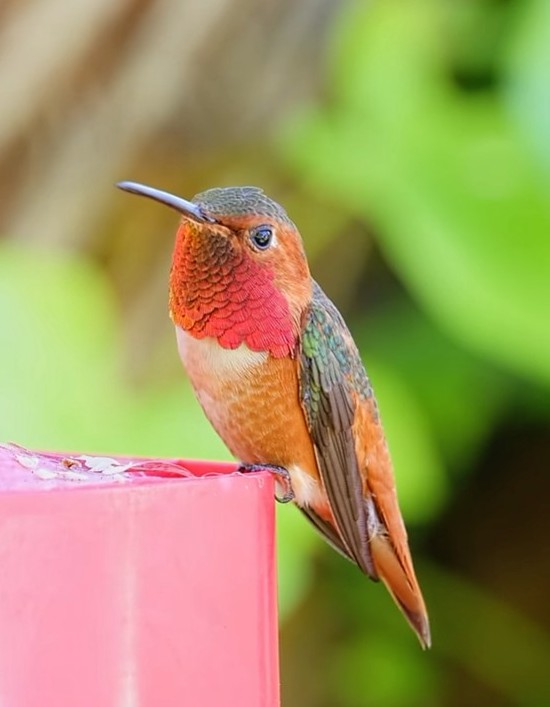
Male Allens Hummingbird
And What Does the Male Hummingbird Do?
This is one of the questions we hear most often when people watch a hummingbird nest:
“Where is Dad?”
The answer surprises many people.
The male hummingbird's reproductive role is essentially to mate with the female and fertilize her eggs. He does not participate in raising the resulting young.
He does not build the nest.
He does not incubate the eggs.
He does not brood the hatchlings.
He does not bring food to the chicks.
He does not help protect or care for the nestlings.
And he does not help raise the fledglings after they leave the nest.
That means virtually everything you see happening throughout the nesting cycle—from the first pieces of nesting material to the final days of caring for fledglings—is accomplished by one extraordinarily dedicated little mother.
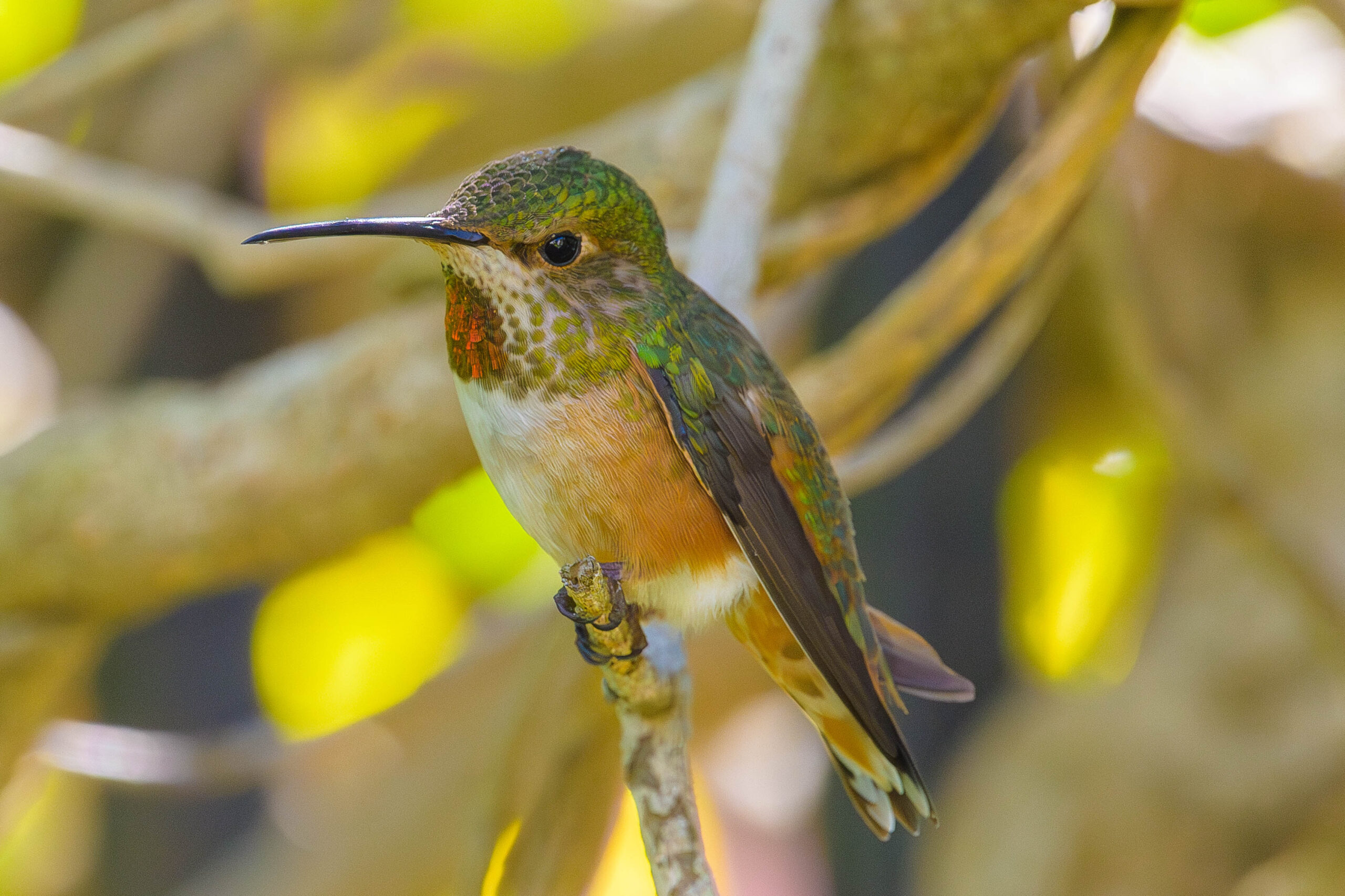
Mom "Olive" Perching in a Tree
One Remarkable Mother
Think about everything she accomplishes.
She chooses the nesting location.
She builds a nest smaller than a golf ball.
She lays two tiny eggs.
She incubates them for roughly two weeks.
She keeps her newborn chicks warm.
She finds enough food to sustain herself and two rapidly growing babies.
She makes trip after trip to feed them.
She protects and cares for them while they grow.
She watches them develop feathers and strengthen their wings.
She continues feeding them until they fledge at approximately 21 to 26 days old.
And after they leave the nest, she continues caring for them while they learn to fly, feed, and survive independently.
And she does all of it on her own.
The Next Time You See Her at Your Feeder...
So the next time you see a female hummingbird repeatedly visiting your flowers or feeder during nesting season, remember:
She may be doing much more than simply feeding herself.
Somewhere nearby, she may have two tiny eggs waiting in a carefully hidden nest.
She may have newly hatched babies that depend on her for warmth.
She may have two rapidly growing chicks waiting for their next meal.
Or she may have recently fledged youngsters hidden among the branches, calling and waiting for Mom to return with food.
That quick visit to your feeder may simply be one stop during another incredibly busy day of raising her family.
She'll take a drink, replenish some of the energy she's constantly burning, and then race away again to continue the job she has been doing entirely by herself.
And if she could leave you a little message before she goes, perhaps it would simply say:
“Thank you for keeping my feeder full. I have a family to raise!”
Somewhere nearby, an incredibly hardworking little mother may be raising the next generation of hummingbirds. ❤️
Thank you so much for your support. Everything we do here is made possible by the dedication of our volunteers and by your generous contributions. Your support helps offset ongoing expenses such as servers, cameras, network equipment, software, internet services, website, and more. Your continued generosity and encouragement truly mean the world to us. This is, without question, a labor of love for everyone involved. ❤️
Venmo @alyssasnaturesanctuary(opens in new tab)
Also check out our Online Store: https://alyssasnaturesanctuary.org/shop(opens in new tab)
And here is a link to things around the Sanctuary: https://amzn.to/4pTJ7ay(opens in new tab)
Help fund us for another year: https://gofund.me/b3fec72e1(opens in new tab)